

Body piercings are body modification practices that involve piercing a part of the body to insert jewelry.
These piercings have ancient origins, used as symbols of divinity, beauty, and social status, or as part of religious or initiation rituals. Later, in more modern times, they first became a form of rebellion and individual expression, and then part of fashion and pop culture.
Among the most requested and popular body piercings today are:
There are other types of body piercings, such as ear piercings, lip piercings (or labret piercings), and facial piercings.
Body piercing: the belly button piercing
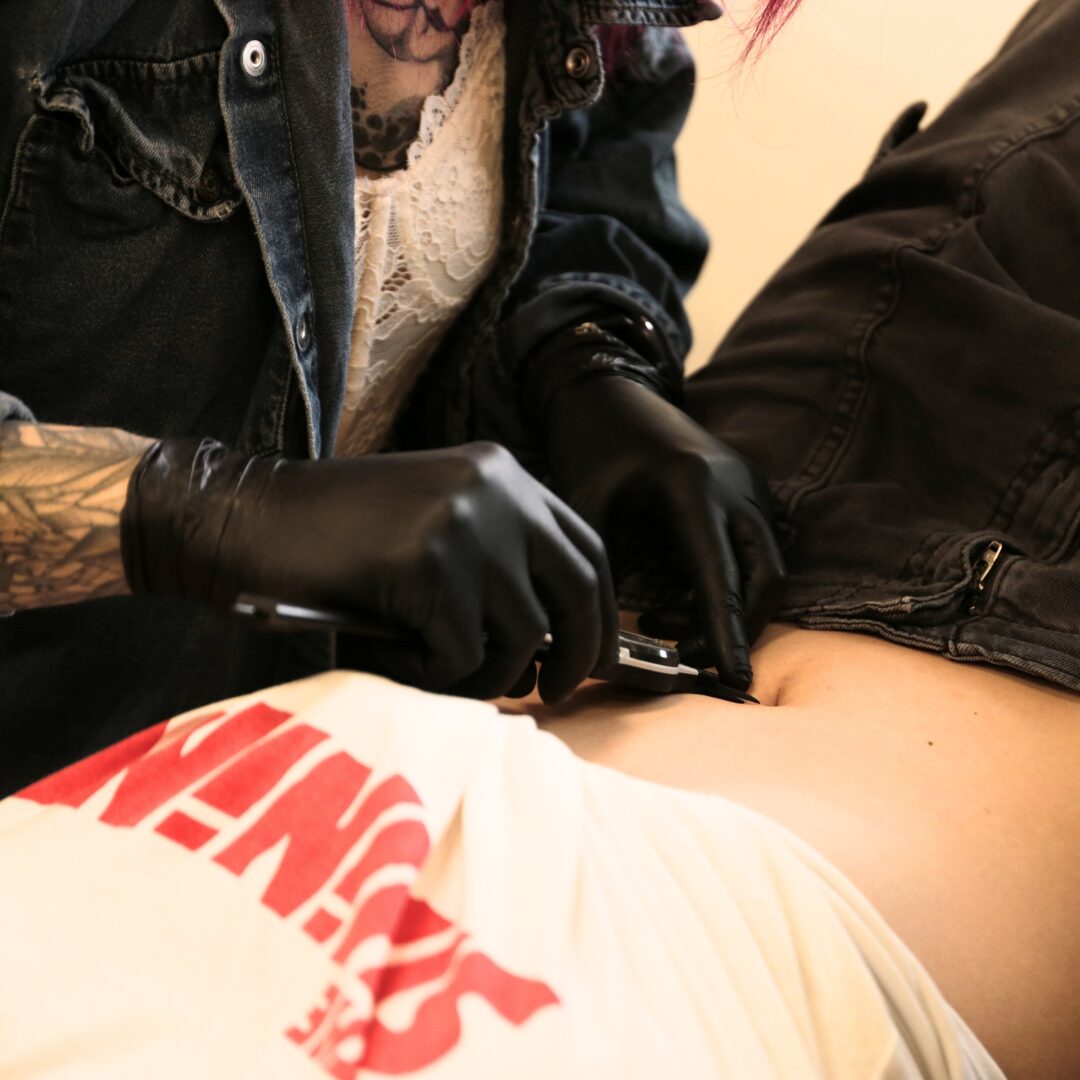
The navel piercing, also called a Navel, is a type of body piercing created by perforating the area inside or around the navel to insert jewelry (it can be done anywhere around the entire circumference of the navel).
This is a predominantly feminine type of piercing, but it is also sometimes requested by men, becoming a true accessory to show off, especially during the warmer months.
This piercing is performed at the most appropriate angle depending on whether the navel is innie or outie, but also based on its shape, which can be:
- Round (the “perfect navel”)
- Oval (the most common navel)
- Almond-shaped
- Hooded
- Slit
Once the hole is made, the Piercer inserts the classic curved barbell with two beads (classic Navel), initially long to allow for potential swelling, which can be replaced once healed.
For jewelry to be inserted after the piercing has healed, there are many shapes and colors: minimal, super bright, and with dangles!
Other jewelry for belly button piercings, the most common and popular, are the Floating Navel (a piece of jewelry with a flat disc or a small bead at the bottom instead of a larger one), the hoop, the clicker, and the Navel with dangles.
A belly button piercing requires a healing period of about 30 days, and an internal settling period that can last for a few months, during which bleeding, stinging and/or swelling, and lymphatic secretion (composed of blood plasma, lymph, and dead cells) are normal.
Belly button piercing technique
To perform a belly button piercing, the Piercer may decide whether to use forceps or proceed freehand to secure and pull the area to be pierced. When it is stable, they insert a sterile orange cannula needle through the skin and insert the initial jewelry using the cannula.
In addition to the classic Navel, which is performed by piercing the upper part of the navel vertically, there are other types of belly button piercings that differ in position and jewelry style:
- Anti-Navel Piercing: also called an inverse belly button piercing, it is performed vertically and the jewelry passes through the lower skin fold of the navel instead of the upper one
- Double Navel Piercing: consists of a combination of two piercings, one above and one below the navel or on the sides
- Lateral Navel Piercing: the skin is pierced vertically on the right or left side of the navel
- Multi Navel Piercing: combines multiple belly button piercings together, often forming a cross
Body piercing: the nipple piercing
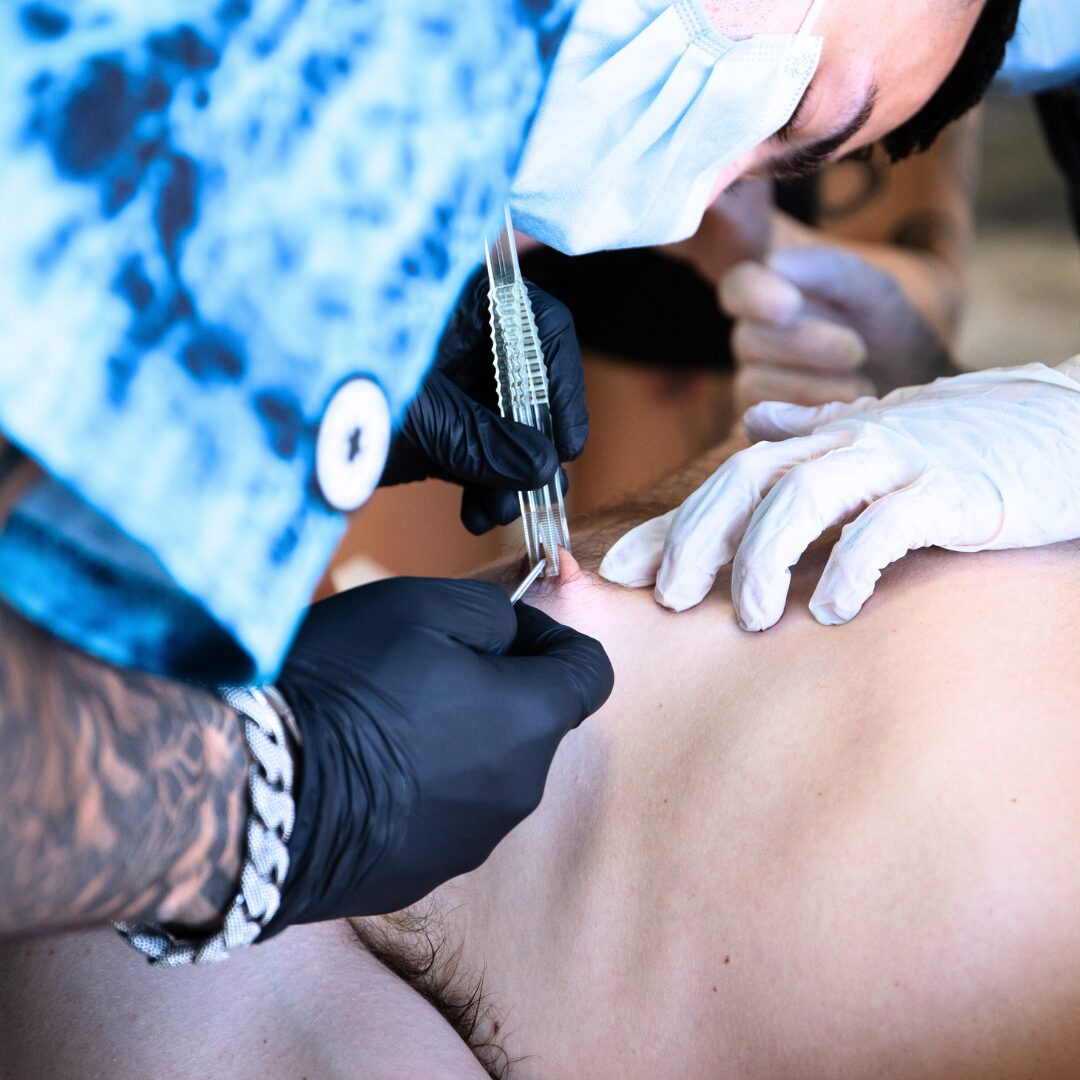
The nipple piercing (or Nipple Piercing) is considered one of the most painful piercings currently in existence due to the delicate and very specific area to be pierced, although it is extremely underrated: if performed quickly, it is not among the most painful piercings at all!
It is one of the most requested piercings in recent years among women and men, performed horizontally, vertically, or at other angles, also depending on the anatomical structure of the nipple, which can be:
- Protruding
- Flat
- Inverted
The healing time for nipple piercings is about a month and requires regular cleaning, monitoring the area, and avoiding friction, irritation, and activities that could cause trauma to the piercing.
Among the most used jewelry for nipple piercings are the straight barbell with beads on both ends (which allows for faster healing), the nipple ring, and Nipple Shields, which surround the nipple.
How a nipple piercing is performed
A nipple piercing is performed by piercing the nipple transversely horizontally, vertically, or diagonally.
In this case as well, the Piercer may decide to proceed using forceps or freehand to secure the nipple, then insert a sterile orange cannula needle and then a barbell.
This technique can also be performed on very small or inverted nipples, though more experience is required.
Surface piercing: innovation in body piercing
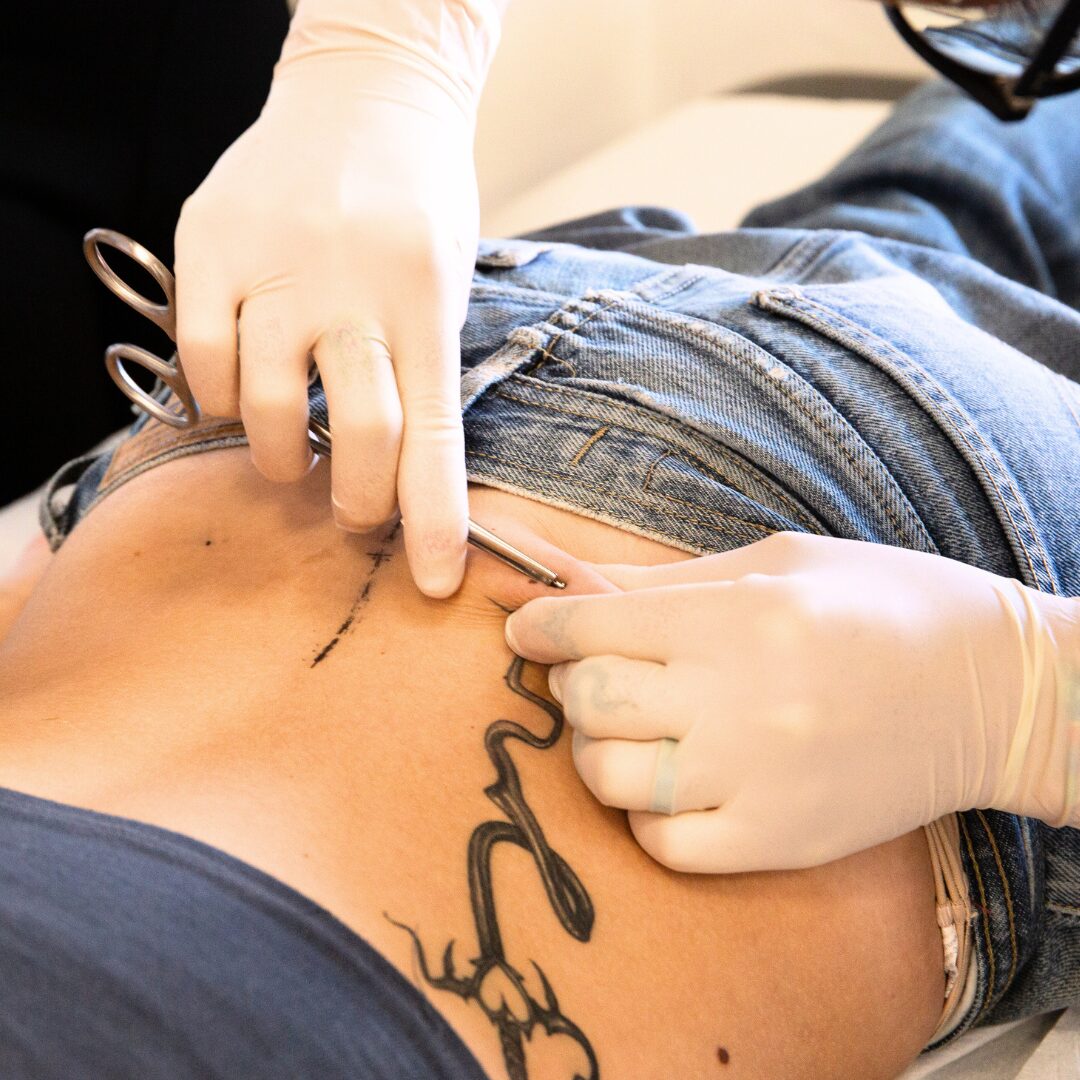
In the world of body piercing, a new type has spread in recent years, very different from all others. We are talking about the Surface piercing, which consists of a piercing that passes through the surface layer of the skin.
It is therefore a subcutaneous piercing done in specific areas of the body where there are no protrusions, where part of the jewelry is under the skin and 2 components remain visible on the outside: flat discs, gems, beads, etc.
For surface piercings, the healing period is about 30 days. Maintenance, recommended daily hygiene, and avoiding hits or trauma to the jewelry are very important.
It is also advisable not to sleep on the side of the piercings during the healing period and not to submerge the piercing in water (sea, pool, spas, saunas, etc.).
It is also best to avoid touching, moving, or pushing the jewelry both during the healing phase and once healed.
In the first few days, bleeding and some inflammation may occur: stinging and/or swelling and redness, just like with any skin wound. Lymphatic secretion is also normal. This does not indicate any complication and shows the piercing’s healing process.
Surface jewelry is made of titanium and has a specific shape to ensure it stays settled under the skin: a bar with two 90-degree bends.
The most common external component is the bead, but flat discs, gems, or other decorations can also be applied as desired, always after healing is complete. Once the piercing has healed, you can change the external components of the jewelry and wear whatever you prefer.
A surface piercing does not last forever: being a superficial piercing, it is subject to skin regeneration, which after a few years will lead to the body rejecting the jewelry.
Most common types of Surface Piercings
A surface piercing consists of 2 holes made at a specific distance based on the size of the jewelry and the area of the body where it is inserted, performed with a needle on a flat part of the body: the jewelry passes through one hole, with the bar under the skin.
Among the most common and requested surface piercings are:
- Vertical Tragus: done in the tragus cartilage
- Sternum: vertically along the sternum
- Surface Clavicle: near the collarbone, just below it
- Surface Nape: on the back of the neck
- Surface Hip: on the hips, often performed symmetrically on both sides
- Surface Wrist: on the outside of the wrist
- Face Surface: on the cheekbone
- Horizontal Eyebrow: positioned horizontally above the eyebrow arch
- Vertical Bridge: vertically on the glabella between the eyebrows
Body piercing: the microdermal piercing
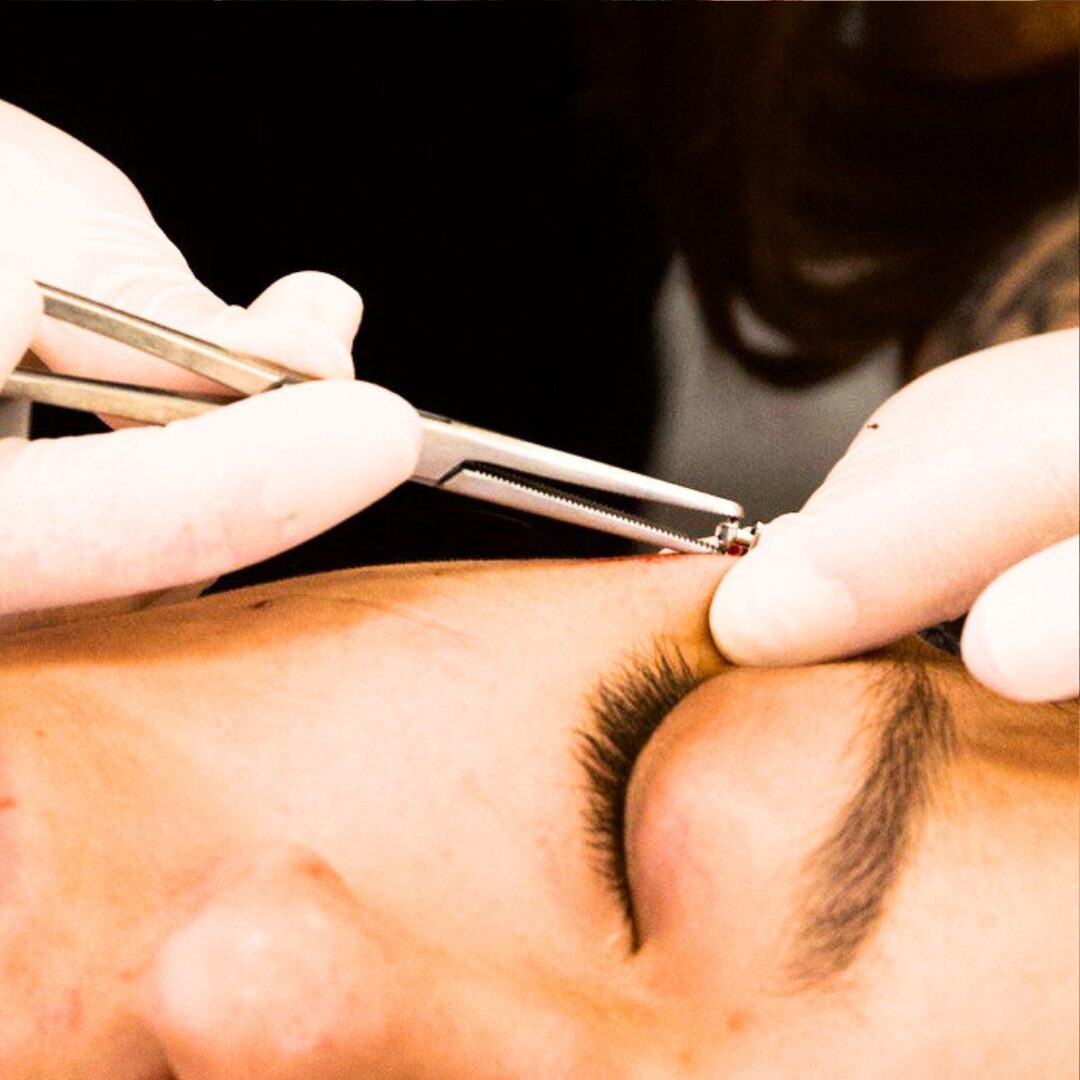
In the world of body modification, there is a form of piercing that is gaining more and more popularity. We are talking about the Microdermal Piercing, a piece of jewelry that can be applied to different parts of the body without going through the skin.
The most requested positions are the cheekbone, sternum, base of the neck, and dimples of Venus, while areas subject to too much movement, joints, and parts like elbows or hands should be avoided.
The Microdermal does not require the use of a needle, but a circular biopsy punch, and it is not performed by crossing the tissue horizontally but vertically.
It then takes about 30 days for the wound to heal, during which tissue grows into the microdermal holes to anchor the jewelry, which consists of a 3-hole flat disc that remains under the skin and a component that can be screwed and unscrewed, which is the visible external part.
Want to know more about Microdermal Piercing?
Read also Microdermal piercing: how it’s installed and the difficulties in performing it
Milano Tattoo School trains future Piercers with professional courses
In the piercing landscape, Milano Tattoo School represents one of the most important schools in the entire European scene, with two highly educational paths dedicated to the piercers of the future.
The first, shorter and in seminar form, is the Technical Piercing Course.
Led by Dimitri Daleno, a world-renowned Piercer with a nearly thirty-year career in the industry, the intensive Technical Piercing course is developed over 4 days of high-intensity training on:
- Dermatology
- Tissue analysis
- Workstation setup
- Safety procedures
- Piercing equipment
- Practical piercing demonstration and 3D video content
- Student practice
- Work techniques
- Piercing jewelry
30 hours of theoretical lessons and practical tests on people for the most requested piercings, intended for artists who want to acquire skills, knowledge, and tools to start or enhance their professional Piercer career.
The next Technical Piercing course starts on July 15, 2024.
There is also a more complete path, totaling 1500 hours: we are talking about the Piercing Operator Course, which allows you to embark on a career as a professional Piercer and obtain the necessary qualification to start working with the issuance of Regional Certification.
This course leads to the development of artistic, technical, and theoretical skills in 3 fundamental steps:
- Classroom lessons to learn knowledge, skills, and tools
- Lab sessions to acquire technique and skills and practice by performing more than 50 piercings on people
- Post-course internship to gain direct experience in a real Piercing studio
The course is led by Dimitri Daleno along with a faculty of professionals in the piercing field, tutors, and high-profile experts in the educational field.
During the program, you also have the opportunity to participate in Workshops and Seminars held by world-renowned Piercers who collaborate with our School, to acquire advanced knowledge and further refine artistic and technical skills, in close contact with the best professionals in the industry.
The next Piercing Operator course starts on September 30, 2024.
Do you want to become a professional piercer?
Discover all the courses at Milano Tattoo School
*All photos are works by MTS students during their first experience performing piercings