
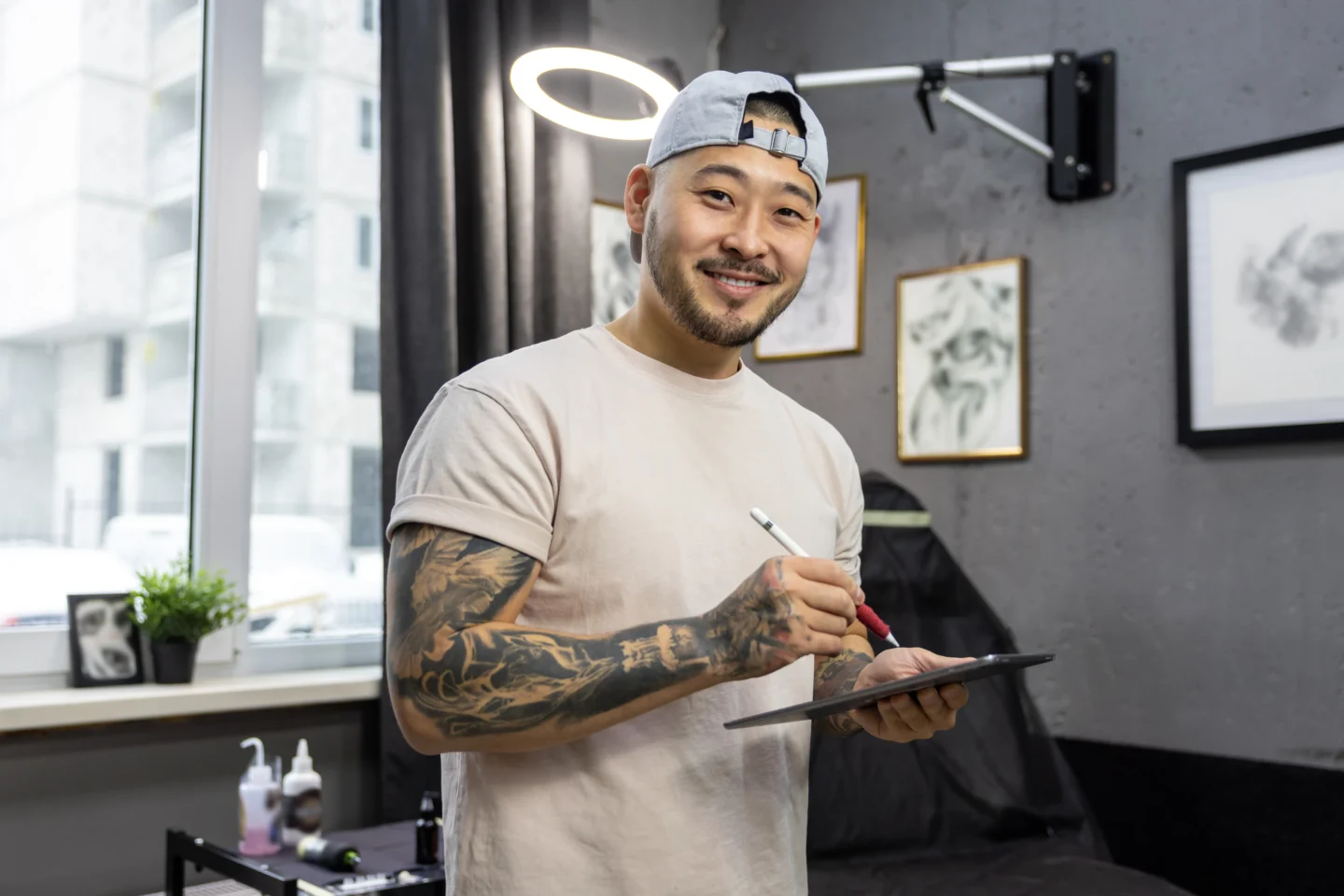
Creating tattoos on synthetic skin is a fundamental opportunity for aspiring tattoo artists who are just starting out or haven’t finished their training yet.
In the tattoo world, after studying and acquiring basic and advanced knowledge, drawing skills, and essential procedures, there is another extremely important part of training for those who want to become a professional tattoo artist.
We are talking about practicing and refining techniques, which is crucial to operating correctly and fully developing this profession.
However, practicing directly on human skin isn’t possible while you’re learning, as you don’t yet have the necessary skills to do an impeccable job and would risk making serious mistakes.
For this reason, fake artificial skin is used. It faithfully reproduces human skin, especially in terms of thickness, and you can practice on it to test the use of the tattoo machine and have an experience very similar to real tattooing.
Why is synthetic skin fundamental for tattoo artists?
As we mentioned before, synthetic skin is primarily designed to allow young, novice tattoo artists to learn and perfect tattoo techniques by realistically simulating the actual tattooing process.
It is therefore identified as a true training tool to practice on over and over again, without the risk of causing damage to clients, in order to:
- Learn basic techniques without worries
- Perfect your manual dexterity
- Develop your own personal style
- Improve control and confidence in tattooing
- Repeat the same design multiple times to improve precision and line fluidity
- Familiarize yourself with needles, inks, and machines
- Practice on different surfaces (flat or curved)
From this perspective, synthetic skin represents a crucial step in every tattoo artist’s training path, allowing them to gain experience and confidence before working on a real person.
However, synthetic skin also serves other purposes.
It can be used, even by more experienced tattoo artists, to test new machines, needles, and inks, so they can get the hang of them before using them on clients. It’s also very useful for those who need to create a professional and varied portfolio without having to tattoo real people.
Different types of synthetic skin: which one to choose?
Synthetic skin can be made of different materials, each with specific characteristics, with softer and more flexible variants to better imitate real skin and others that are more rigid; it can also be reusable or disposable.
The most common type, as well as the most similar to human skin and therefore absolutely realistic in terms of consistency and reaction, is silicone, ideal for those who want to get as close as possible to a real experience.
Then there is latex synthetic skin, which is cheaper and very flexible, but less realistic than silicone. For this reason, it’s a good option exclusively for basic exercises on lines and shading.
For those who want to practice on a stiffer surface that tends to absorb less ink, there is PVC and plastic material synthetic skin, while for those looking for a tattooing experience very close to reality but less expensive than latex, there is extremely elastic advanced gel synthetic skin.
The advice, especially for beginners, is to experiment with different types of skin to learn how to tattoo in all conditions. Conversely, those who are already at an advanced level should focus on products made of high-quality materials.
How to tattoo on synthetic skin: techniques and tips
To learn how to tattoo best on synthetic skin, the only thing you really need is practice: only by practicing and trying repeatedly is it possible to get comfortable with the consistency, as well as with the tools of the trade.
However, there are a series of techniques and strategies that can speed up this process and give the tattoo artist more familiarity when approaching synthetic skin, maximizing the effectiveness of the practice sessions.
First of all, it’s very important to handle synthetic skin under proper hygienic conditions. This means washing it carefully to remove any dust or impurities and drying it completely before starting to tattoo, to ensure a clean and moisture-free surface.
It’s also fundamental, to make the work easier, to cut the area to be tattooed into a suitable shape that makes it easier to use.
You then need to apply the stencil by pressing firmly to transfer the tattoo image onto the skin, then gently lift the paper and let it dry before proceeding with Vaseline, which is useful for keeping the surface hydrated and reducing needle friction.
Using professional inks is another essential tip, as it helps you get used to working with the same tools you’ll use on clients, as is constantly cleaning the surface so that excess ink doesn’t build up.
Finally, remember to adjust the needle depth as best as possible: even if it’s not real skin, understanding how to adapt pressure and angle allows you to get precise lines even when you move on to tattooing a person.
Common mistakes when practicing on synthetic skin
On synthetic skin, you can make the same mistakes as on normal skin. For this reason, using it consistently allows you to learn how to tattoo correctly and eliminate this risk when you move on to tattooing a real person.
Among the most common mistakes that can compromise the quality of the practice, we find:
- Excessive needle pressure: if you press too hard, there’s a risk of cutting the material instead of correctly depositing the ink. The same applies to insufficient pressure, which can lead to irregular lines or uneven shading
- Use of unsuitable inks: some cheap inks don’t behave realistically on synthetic skin, altering the perception of the stroke
- Not following proper hygiene and cleaning: even on synthetic skin, maintaining a clean work environment helps develop good habits for the future
- Incorrect stencil transfer: if it’s left on for too little time, applied unevenly, or the skin isn’t properly prepared, the stencil won’t adhere correctly or will smudge, which can compromise the entire tattoo.
- Not trying different synthetic skins: it’s fundamental to practice on multiple types of synthetic skin to avoid neglecting practice on future curved body parts.
Avoiding these mistakes allows you to get the maximum benefit from practice and refine your technique effectively.
Tattoo courses at Milano Tattoo School
For those who want to start a professional career in the tattoo world, Milano Tattoo School offers specialized courses to become certified tattoo operators.
Our 1500-hour course includes theoretical and practical training: students learn gradually, starting from the use of synthetic skin and moving on to practicing on real skin under the supervision of experts.
They can also delve into all the most common tattoo styles and professional techniques: lines, shading, packing, and tattoo hygiene are covered in depth.
Furthermore, throughout the program, they use professional equipment: high-quality machines, needles, and inks are provided to students for effective learning.
Finally, after an internship at MTS-affiliated studios and the final exam, they receive a recognized Regional Certification, which allows them to work legally in the sector.
Enrolling at Milano Tattoo School means becoming part of a high-level educational reality that prepares future tattoo artists with competence and professionalism.
Our next upcoming Tattoo Operator courses are:
- April 7, 2025
- September 1, 2025
Visit the page dedicated to Tattoo Operator Courses to enroll