
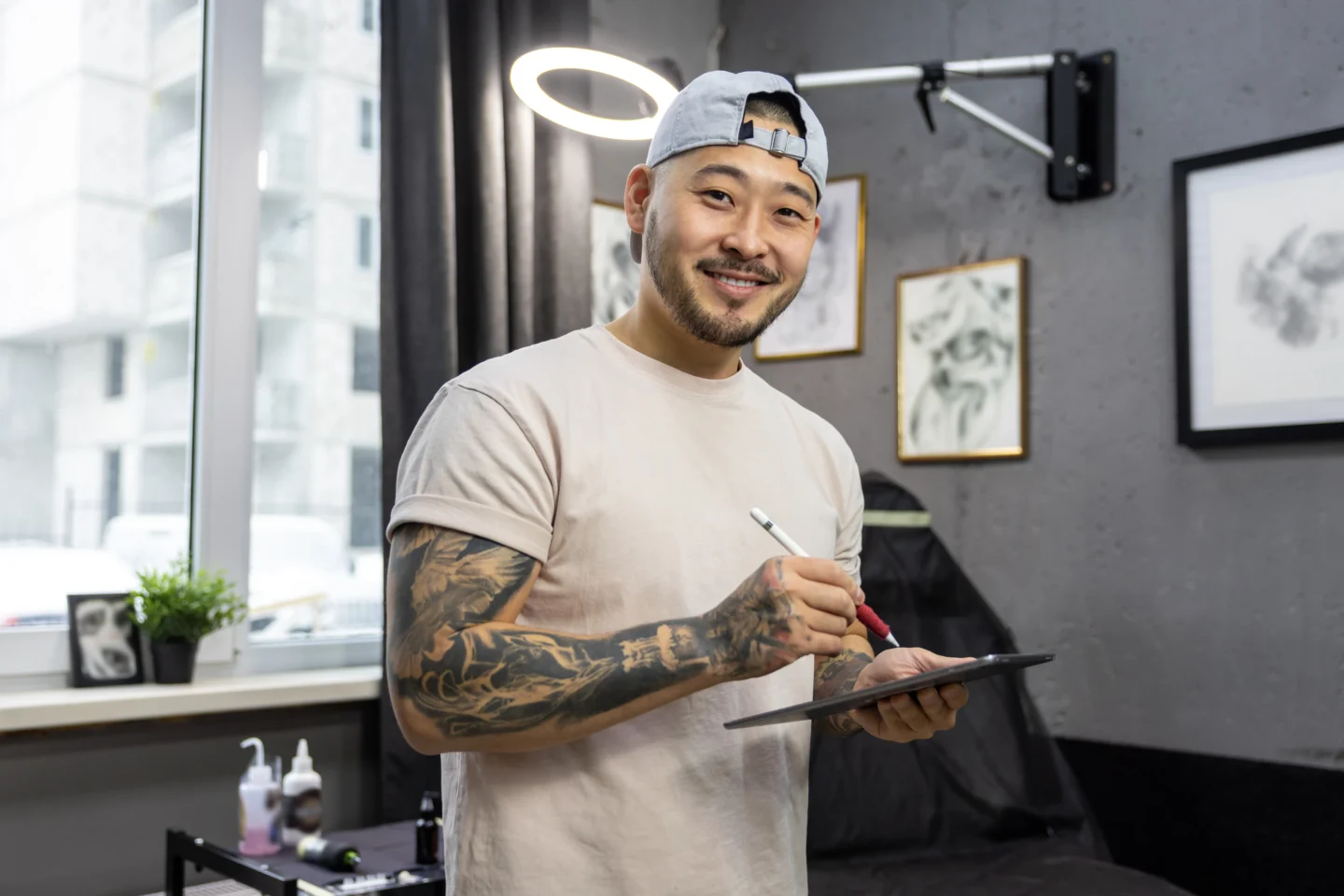
Milano Tattoo School is the most important school specialized in the training of professional tattoo artists, accredited by the Lombardy Region and recognized both in Italy and internationally.
With 1,500-hour programs specifically designed for those who want to become tattoo artists and developed through theoretical lessons, lab practice, live demonstrations, workshops, seminars, and internships, it represents excellence in the tattoo industry.
“Learning to tattoo – explains Katia Polastri, Founder and Director of the School and Head of Tattooing Instruction – requires passion and dedication, but also practice and a deep understanding of art and technique. The path to becoming a tattoo artist involves acquiring artistic skills, knowledge of health and safety regulations and specific tools, and respect for people’s skin.”
In this article, we want to offer some tips for those who wish to embark on this journey and become a professional tattoo artist.
- Train drawing skills and artistic knowledge
- Gain manual dexterity with tools and techniques
- Choose the right equipment
- Embark on a professional training path
Learning to tattoo: training drawing and artistic knowledge
As obvious as it may be, it is worth emphasizing that drawing is a fundamental element in the world of tattoos, as it allows for the creation of original and personalized designs and satisfying all the wishes of clients by transforming their requests into works on paper.
For this reason, mastering drawing and developing good drawing skills is essential for anyone who wants to become a professional tattoo artist.
Equally important is experimenting with different artistic techniques, such as realism, lettering, traditional style, minimalism, etc., to have the knowledge and versatility necessary to carry out this profession.
To improve this part, it is therefore recommended to practice freehand drawing regularly, study color theory, shadows, and perspectives, and learn to draw on curved surfaces similar to human skin. Furthermore, it is good to study various artistic movements and learn to recognize styles until you make them your own.
Learning to tattoo: gaining manual dexterity with tools and techniques
Like drawing, manual dexterity is a talent that a good tattoo artist absolutely cannot lack. This can be natural or not, but it must necessarily be practiced as much as possible both to tattoo the right way and to gain confidence with the equipment.
The best strategy is to initially practice on synthetic skin or other materials somewhat similar to human skin in consistency, starting with simple drawings and then testing yourself with increasingly complex designs.
This allows you to progressively perfect your technique and keep your hand steady even in the most difficult steps to:
- Ensure extreme attention to detail, lines, and shading of the tattoo
- Master different styles and apply various techniques fluidly
- Control pressure and manage the speed of the tattoo machine
- Avoid mistakes that could damage the skin or cause excessive pain
- Adapt your movements to the curves of the body and the most difficult areas
- Maintain consistent quality even during long sessions
- Adapt quickly to unexpected situations and know how to modify the work “on the fly”
Learning to tattoo: choosing the right equipment
The right equipment is essential for a tattoo artist’s success: it is important to choose each tool carefully, as it constitutes a fundamental part of the work.
The first element, which is also the most important, is the tattoo machine.
There are several models on the market, mainly distinguished between traditional tattoo machines and wireless tattoo machines.
The former can be coil machines, which use a system of electromagnetic coils that move a metal bar equipped with needles that penetrate the skin, or rotary machines, characterized by an electric motor that moves the needles continuously and fluidly.
Among the most modern machines are wireless tattoo machines: precise and less traumatic for the skin, they are battery-operated, so without cables and power supplies, and guarantee freedom of movement, better dexterity, and total comfort of use.
In addition to the machines, needles and tattoo inks are also fundamental.
The former have the task of placing the color under the skin and can be of various types that differ in diameter, length, and material.
The latter must strictly be professional, certified, and high-quality to be sure they are safe and thus avoid health damage.
Finally, all hygiene and sterilization products are also essential, such as machine covers, gloves, operator protection, and products useful for disinfecting surfaces and the workstation.
Learning to tattoo: choosing a complete training path
Like any trade, being a tattoo artist requires a specific training path to deepen skills, knowledge, and abilities and be able to operate professionally in the market.
By law (Regional Law n.13 of July 23, 2021), this path must have a duration of 1,500 hours and must be divided between theoretical lessons, practice, internship, and a final exam: this is the only recognized process to obtain the Regional Certification, valid throughout the national and European territory, and the health and safety authorization for the profession, necessary to operate.
This type of path allows you to:
- Develop a solid base of knowledge and skills in the industry
- Learn basic tattooing techniques
- Know the different tattoo styles
- Learn to respect all hygiene and health regulations established by the competent authorities
- Improve artistic skills
- Refine techniques
- Learn to manage tools
- Develop your own personal style
Not only that: a professional training path goes beyond the theoretical and practical aspects, providing essential knowledge and skills in the fields of communication, marketing, and studio management. Knowing how to listen to and interpret clients’ ideas is indeed fundamental to doing this job at its best.
How to become a professional tattoo artist with Milano Tattoo School
There are tattoo courses that give a general overview and then there are complete and highly educational courses, developed to provide a wide range of skills, tools, techniques, and essential skills to become a great professional.
The Tattoo Operator Course at Milano Tattoo School belongs to this second category.
We offer you 1,500 hours of specific training, theoretical lessons on essential subjects, lab practice to perfect your technique, and an internship to gain experience and acquire all the skills necessary to work in the industry.
All 2024 courses are officially Sold Out, but we have opened registrations for the new year.
In January 2025, the first tattoo course of the year starts at Milano Tattoo School, leading you to become a professional tattoo artist with high-level training.
Why choose Milano Tattoo School?
- Certified training: at the end of the course, you will obtain the Professional Certification from the Lombardy Region, valid in Italy and throughout Europe, to legally practice the profession of tattoo artist
- Expert instructors: 20 master tattoo artists with over 20 years of experience, ready to guide you step by step in learning the most requested techniques and styles
- Practical and progressive approach: you will learn to master lines, fills, shading, and colors, working on paper, iPad, synthetic skin, and finally on real models
- Tattoo styles: From old school to realism, from Japanese to fine line, every style will be explored with specialized instructors
- Exclusive workshops: you will participate in labs, seminars, live demonstrations, and meetings with world-renowned artists and tattooists
- Networking opportunities: with over 400 partner tattoo studios, you will have access to internships and essential, highly specialized job opportunities
With MTS training, you will become a complete, qualified tattoo artist ready to work in the industry.
Visit the page dedicated to the upcoming Tattoo Operator Courses