

We continue our series of articles on piercings with another highly requested one.
The Bridge piercing is performed on the upper part of the nasal septum, between the eyes, which explains the name “bridge,” as it seems to form a bridge between the eyes.
There are two types of bridge piercings: the horizontal and the vertical bridge.
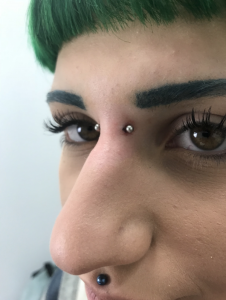 The Bridge piercing can have two versions:
The first is the most common,
where it is placed horizontally.
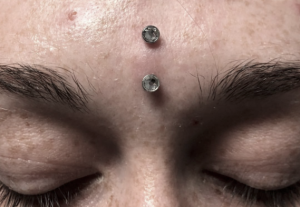 The second, a bit less common,
is where it is positioned vertically,
thus a surface piercing aligned
at eye level or higher, on the forehead.
HEALING:
As part of the surface piercing category, the healing period is a longer process compared to other types of piercings. Furthermore, it has a higher probability of rejection than other piercings. For this reason, it is advisable not to touch it more than necessary. If recognized in time, rejection can be managed by consulting your trusted piercer.
EXECUTION:
The piercer grasps the skin of the nose with forceps, lifting it from the bone, and performs two aligned holes. The alignment of the holes is crucial, because if the holes are not aligned, the piercing will be crooked, resulting in a very unpleasant effect on facial symmetry. The pain is average, as it is an area where the skin has little sensitivity.
The Bridge piercing can have two versions:
The first is the most common,
where it is placed horizontally.
The second, a bit less common,
is where it is positioned vertically,
thus a surface piercing aligned
at eye level or higher, on the forehead.
HEALING:
As part of the surface piercing category, the healing period is a longer process compared to other types of piercings. Furthermore, it has a higher probability of rejection than other piercings. For this reason, it is advisable not to touch it more than necessary. If recognized in time, rejection can be managed by consulting your trusted piercer.