

In the vast world of ear piercings, there is a particularly elegant, discreet, and uniquely fascinating type.
We are talking about the Daith Piercing, a piercing located in the part of the ear just above the ear canal, next to the tragus and the earlobe attachment.
Since it is a thin and small area, the Daith can often heal very quickly (thanks mainly to its somewhat hidden position), but it can often be particularly painful to perform (it is usually considered one of the most painful piercings during the procedure).
There’s also an interesting fact: according to some beliefs, this piercing has a potential therapeutic benefit, as it is said to stimulate a pressure point linked to headache and migraine relief. Of course, there is no scientific evidence to support this yet.
In this article, we will delve into Daith Piercing, explaining its main characteristics, the correct execution technique, and the most common complications that can arise from this piercing.
Key Characteristics of Daith Piercing
As we explained earlier, the Daith is that particular piercing located in the cartilage fold of the ear, just above the tragus.
Compared to other ear piercings, the Daith has a fixed and precise placement that cannot be changed. However, you can customize the jewelry, making the piercing unique and different from all others.
There are countless jewelry options in both titanium and gold, specifically designed for this piercing.
From the most classic and simple rings to more elaborate and decorated ones, elegant, eccentric, in all colors, and with precious and semi-precious stones.
Being performed in a very specific area, the piercing is visible, yet absolutely discreet, which is why it is very popular at all ages.
Furthermore, it is a very modern piercing, chosen by several celebrities and public figures, who have helped make it even more popular.
Finally, being less common than the Tragus or Helix, it gives great originality to the wearer, drawing all eyes to it.
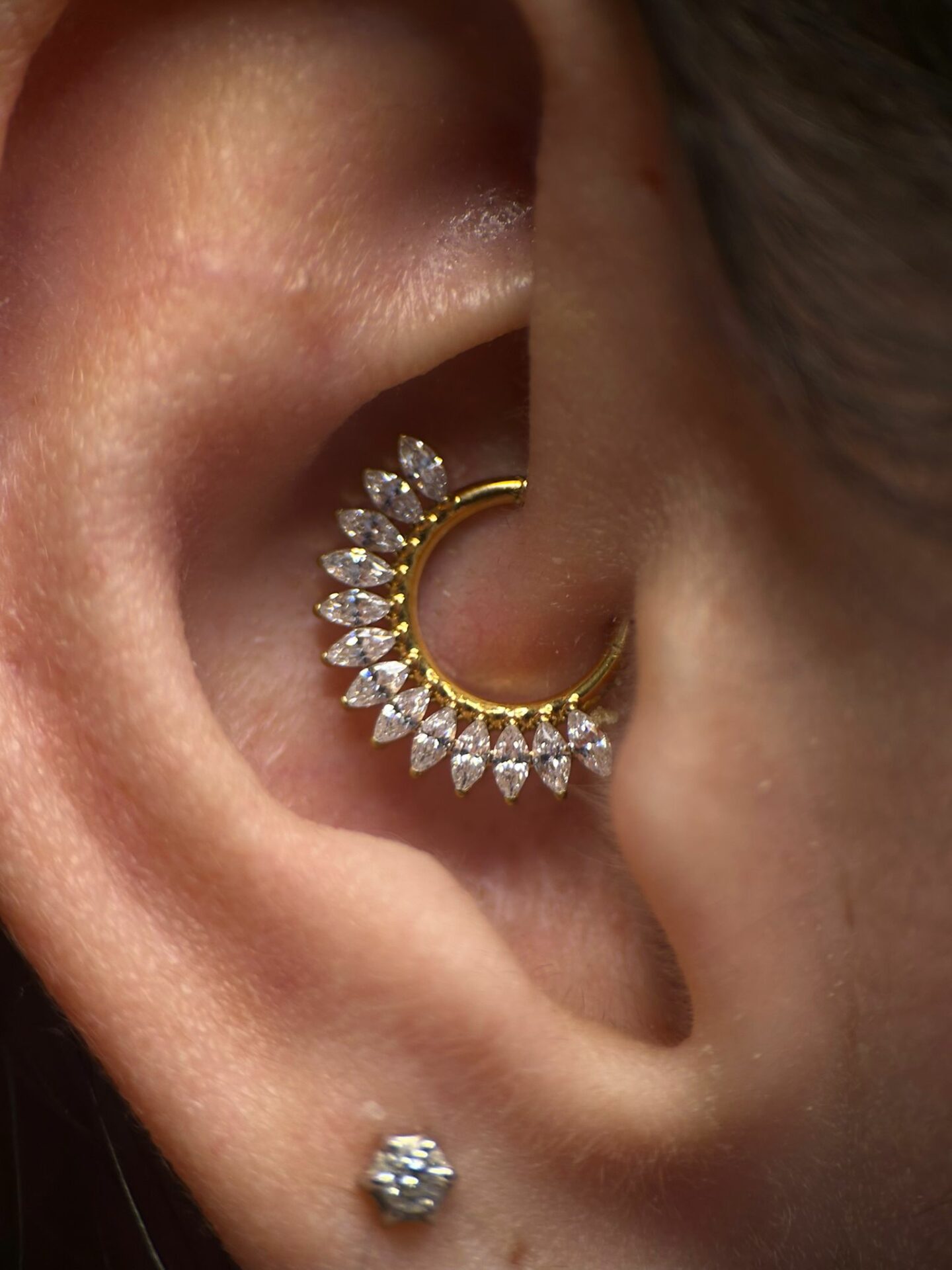
Daith Piercing: Tips for a Flawless Execution
Due to its delicate position, Daith Piercing must always be performed by experienced Piercers who understand anatomy and possess perfect technique and dexterity.
First of all, the area must be thoroughly cleaned and disinfected to prepare that flap of cartilage inside the ear for the piercing.
After that, the exact spot is marked, and the helix root is pierced, which must be done with a sterile cannula needle.
Once this is done, a titanium curved barbell must be immediately inserted with the help of an essential tool (the mosquito clamp), as it is less invasive during the initial healing period.
The healing time ranges from one month to a year, depending on each individual’s body. During this period, it is important to:
- clean the piercing twice a day with a saline solution or a specific piercing product (especially after the initial piercing) and then continue with regular and thorough cleaning
- do not touch the piercing with dirty hands
- avoid rotating or moving the jewelry
- avoid swimming pools, the sea, and hot tubs until complete healing, at least for the first 2 weeks
The Most Common Complications and Errors in Daith Piercing
Due to its particular position, the Daith Piercing is particularly difficult to perform without the right experience and necessary technical skills.
Among the most common errors a Piercer can make due to insufficient knowledge is certainly incorrect placement: in these cases, the hole is made in the wrong area (for example, too close to the cartilage edges with a risk of rejection, or too far inward, making it difficult to care for/clean and thus prolonging healing). This is in addition to the aesthetic factor, of course.
Another possible error is incorrectly perforating the cartilage, causing it to break or leading to chronic pain for the client, or a longer and more difficult healing process. This happens when the technique is wrong, or when inadequate tools are chosen.
Even inserting jewelry of the wrong size can compromise the piercing’s outcome, potentially causing irritation, infection, or rejection.
Finally, an error many novice Piercers make is not providing clear aftercare instructions, especially regarding the timing for jewelry replacement.
Difference Between Daith Piercing, Conch Piercing, and Helix Piercing
Daith Piercing, Conch Piercing, and Helix Piercing are three types of ear piercings that differ for several reasons.
First of all, the placement changes:
- The Daith Piercing goes through the innermost cartilage of the ear, located above the ear canal.
- The Conch Piercing is done in the center of the ear cartilage and can be internal (the hollow area near the ear canal) or external (towards the edge of the cartilage).
- The Helix Piercing is located on the outer part of the upper cartilage of the ear
The aesthetic impact also differs, as the Daith is more discreet and elegant, the Conch is edgy and modern, and the Helix is original and versatile, often combined with multiple holes (double helix, triple helix).
Healing and pain during execution are very subjective. Usually, the helix can take longer to heal due to its external position being constantly stimulated by daily activities, while conch and daith, being more internal, often heal faster.
Milano Tattoo School’s Piercing Courses
At Milano Tattoo School, various programs are available to become a professional Piercer and specialize in this field.
The most comprehensive and well-known is the Piercing Operator Course, a complete 1500-hour training program that allows you to:
- acquire the necessary knowledge and skills as a professional piercer
- gain all the fundamental tools to enter the job market
- manage and perform the future profession of piercing operator independently
- grow and stand out in the piercing landscape
- access internship opportunities at studios in Lombardy
- Obtain Regional Certification recognized throughout the national and European territory
The course is divided into theoretical classroom lessons and laboratory sessions conducted by a team of highly qualified experts and developed through the use of advanced technologies, innovative teaching methods, and high-quality equipment.
In addition to technical skills, the course covers aspects such as client psychology, marketing, shop management, and post-piercing care, providing a solid foundation for starting a rewarding and successful career.
The technical piercing course is also active: 30 hours of training dedicated to all those who want to deepen their knowledge of techniques, tools, procedures, and practices with lessons on:
- Basic Principles of Dermatology and thorough tissue analysis
- Workstation preparation, material safety, equipment usage
- Analysis of piercing jewelry types and application
- Piercing execution techniques with cannula needle, with forceps, and Free-hand
- Illustration of problems during and after execution, and specific aftercare
- Practical demonstration
This course consists of theoretical lessons with piercing demonstrations by the instructor and practical lessons where students perform various piercings.