

Facial piercings, also called Face Piercings, involve piercing the skin of the face to insert jewelry.
These are obviously very visible piercings that, once removed, can leave a scar. Therefore, before getting them, it’s important to carefully evaluate the aesthetic impact and long-term effects.
There are many piercing options available for the face, each with its own aesthetic and meaning. The most common and popular Face Piercings are:
Face Piercing: The Eyebrow Piercing
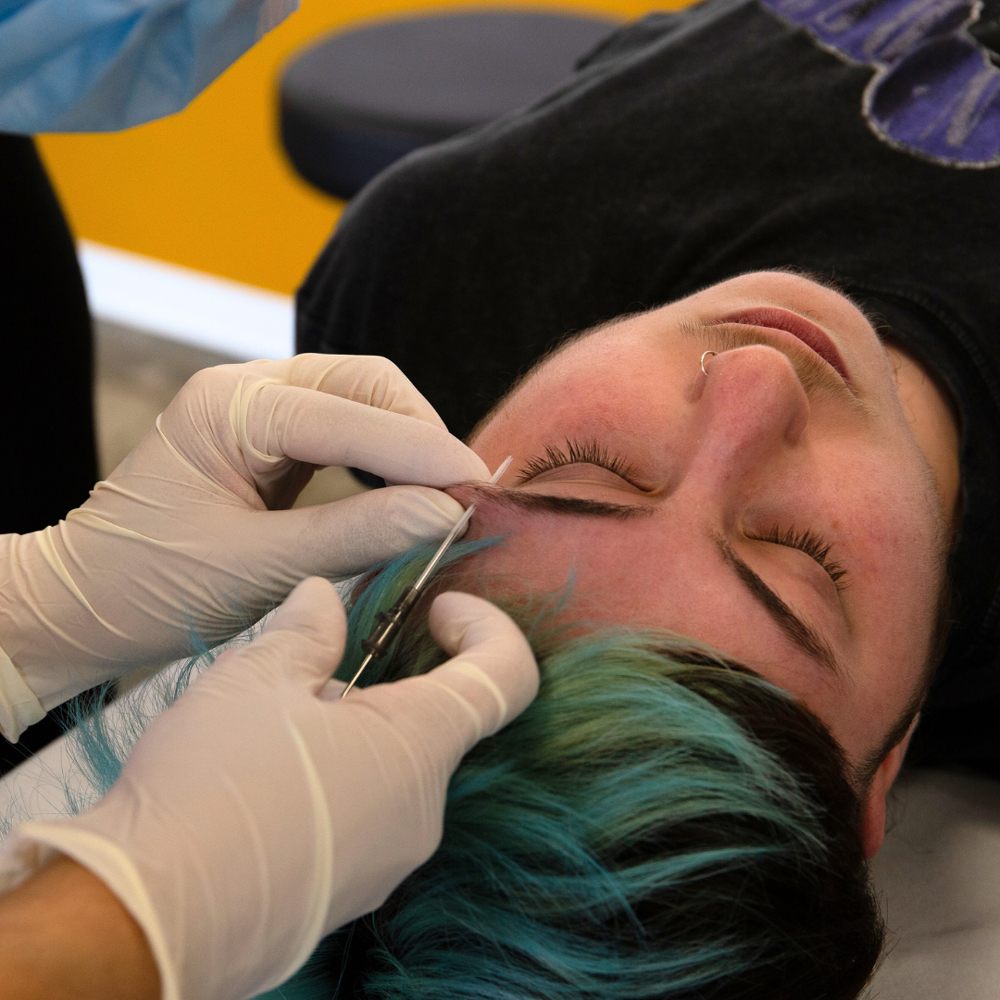
The eyebrow piercing is one of the most popular for enhancing facial lines and the gaze. It is placed on the brow bone near the eye area, angled approximately 30 degrees to harmonize with the face’s shape.
It can also be placed further inward based on the client’s preference, or even in the center of the eyebrow.
There is another type called Horizontal Eyebrow which differs from the classic eyebrow piercing because it is a surface piercing.
The vertical eyebrow piercing (the classic commercial one we all know) is done at the outer edge of the brow bone, passing vertically and slightly at an angle with two holes above the eye.
In the horizontal one, the two holes remain above the eyebrow, obviously positioned horizontally. As it’s a surface piercing, the jewelry inserted is a flat bar with two 90-degree angles.
However, it is not a very common or requested piercing.
Technical Execution of the Eyebrow Piercing
The eyebrow piercing is performed with a sterile gray disposable cannula needle, piercing at an angle of 30 degrees relative to the outermost part of the eye. The area to be pierced is first marked with a dot and then “grasped” with forceps to secure the tissue. After the piercing, a curved barbell is inserted, which will later be replaced with a shorter piece of jewelry. Healing time ranges from 2 to 4 months.
Facial Piercing: The Nose Piercing
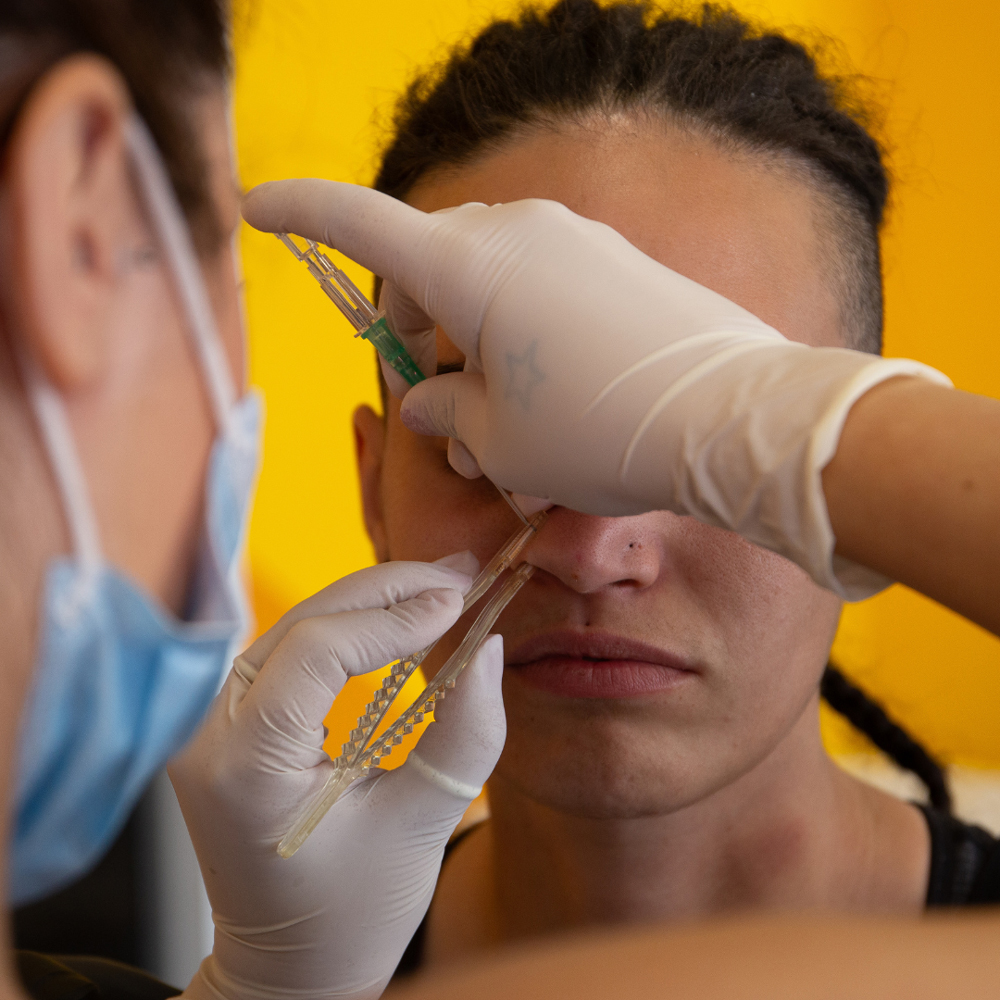
Nose piercings aim to pierce the skin of the nostril or nasal septum to insert jewelry. Like eyebrow piercings, they are highly requested by people of all ages, as they appear minimal and refined on both men and women.
Depending on the placement of the piercing, different types of nose piercings can be distinguished.
Let’s start with the most common, the Nostril, also known as a nostril piercing, where the side of the nostril, right or left, is pierced to insert a ring, stud, or bead. When the jewelry is placed higher up on the side of the nose, the piercing is called a High Nostril Piercing.
Then there’s the Septum, or piercing at the base of the nasal septum: to create it, the cartilage is not pierced, but a very thin layer of tissue that crosses the nasal septum and separates the two nostrils, where the piercer applies the jewelry.
More recently, the Bridge piercing has become very trendy, a surface piercing that affects the upper part of the nasal septum: the piercing is performed by horizontally or vertically (Vertical Bridge) passing through the skin above the bridge of the nose, between the two eyes, between the glabella and the nasal bone, where a bar with two beads is then positioned.
Technical Execution of the Nose Piercing
Nose piercings are performed using a specific sterile gray needle for the septum, green for the nostril.
Healing depends on the person and the type of nose piercing, but it usually takes a few months for the nostril and less than a month for the septum.
Facial Piercing: The Lip Piercing
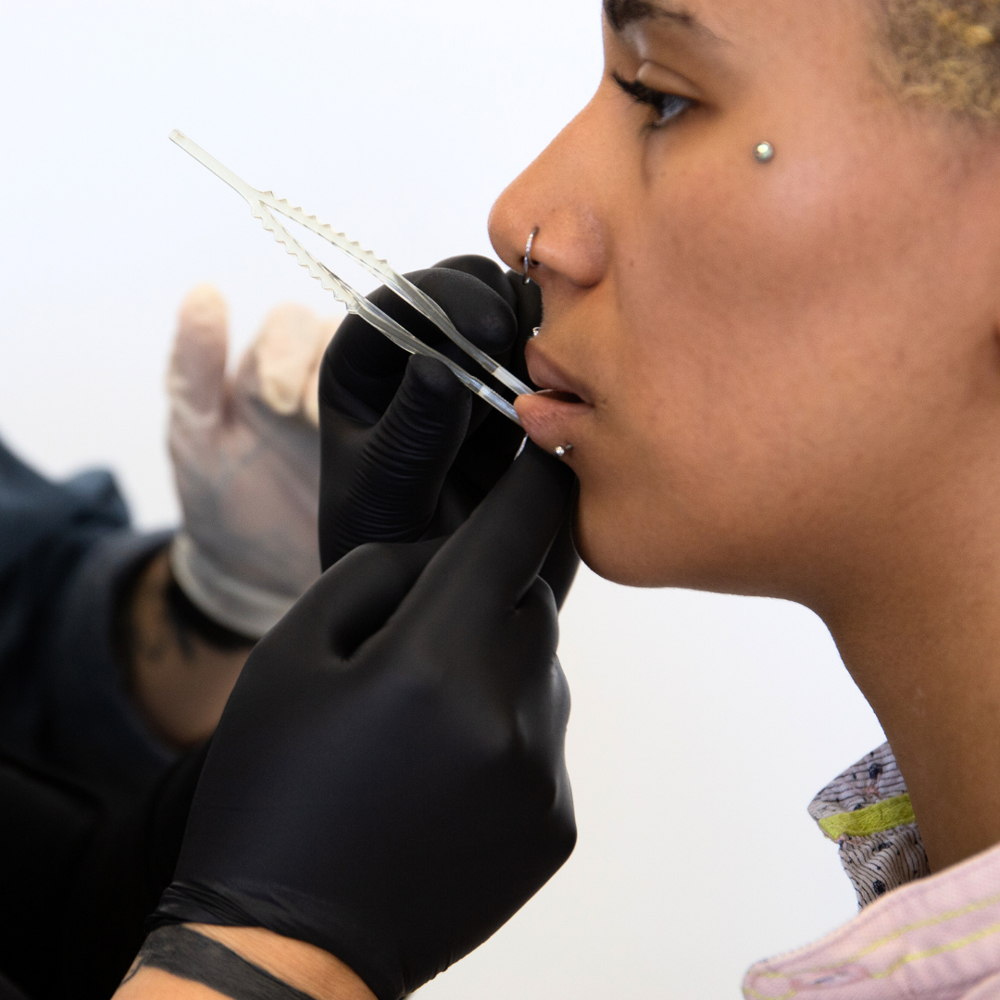
Piercings involving the lips are called Labret Piercings. Today they are considered an aesthetic asset, but in the past, these piercings were used as a sign of social status, group affiliation, or for spiritual reasons.
There are different types of lip piercings, each with its own style and placement. The most classic and common is the Central Labret, positioned in the center below the lower lip and adorned with a ring or a stud.
When the skin above the upper lip and below the nasal septum is pierced centrally, forming a right angle with the existing tissue, you get what is called a Medusa Piercing, which accentuates the shape of the lip.
The Lateral Labret, on the other hand, is a piercing positioned laterally on the lower and upper lip, to the right or left, and is distinguished as:
- Marilyn, placed above the left lip
- Madonna, placed above the right lip
- Angel Bite, involves two perforations on the upper side of the upper lip
- Snake Bite, involves two perforations on the lower side of the lower lip, resembling a snake bite
Then there’s the Vertical Labret: this involves 2 holes in the lower lip, one in the upper part of the lip and one at the bottom end of the lip, with the jewelry passing vertically inside.
Finally, two other highly requested types of lip piercings are the Ashley Piercing (inserted in the center of the lower lip and exiting on the inside) and the Dahlia Piercing (2 piercings located laterally at the corners of the mouth where the two lips meet).
Technical Execution of the Lip Piercing
To perform a labret piercing, the area is first disinfected, and then the exact spot where the piercing will be placed is identified by marking a dot. At this point, the piercer, using a gray cannula needle, performs the piercing through the lip at the pre-selected spot, using sterile forceps to secure the area and at a 90-degree angle. Once the perforation is made, the jewelry is inserted with a flat back on the inside and a bead on the outside (except for the vertical Labret, which uses a curved barbell), passed through the newly created hole.
Facial Piercing: The Tongue Piercing
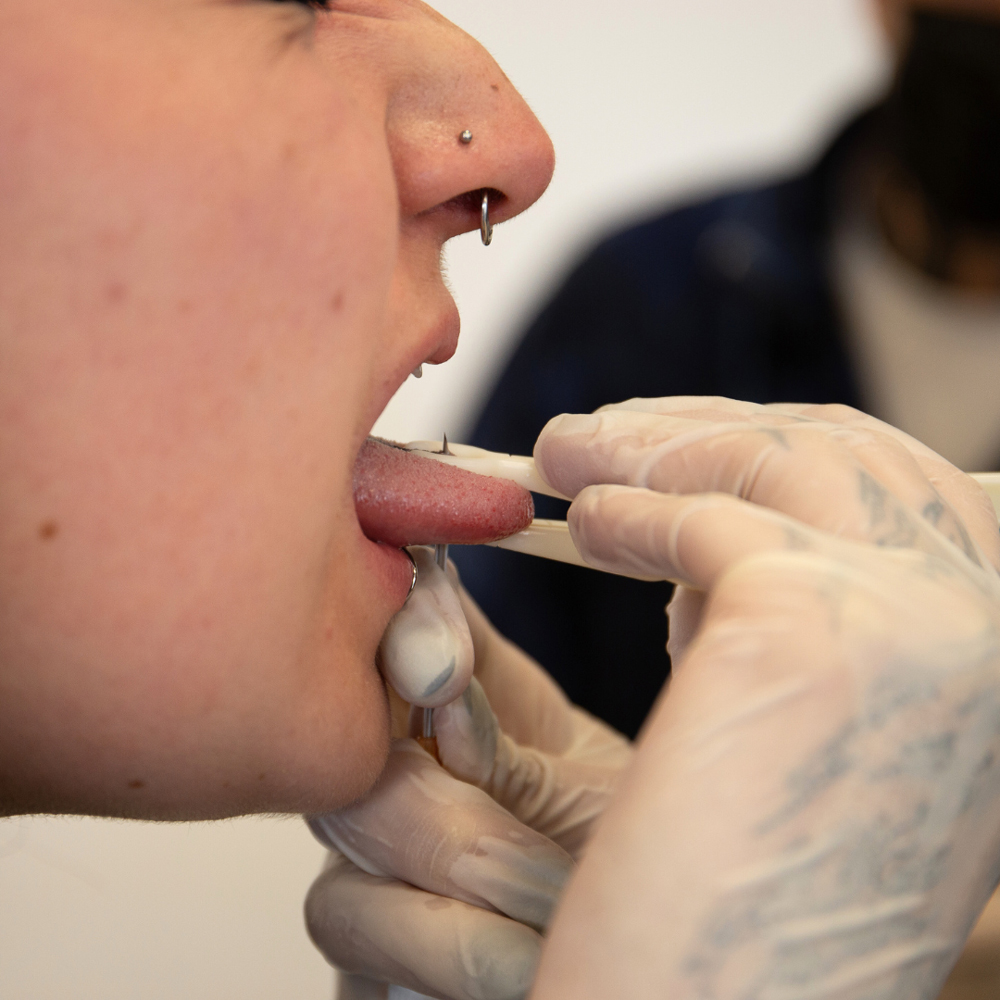
The Tongue Piercing involves perforating the muscular tissue of the tongue and subsequently inserting a barbell with two spheres at its ends.
In addition to the classic tongue piercing, there are several other variations that no professional performs anymore:
- Venom Piercing: a double piercing, one on the right and one on the left, positioned vertically through the tongue muscle
- Snake Eyes Piercing: a more superficial piercing that perforates the tongue horizontally at the tip
There are also other minimally invasive piercings in the oral cavity that not everyone can have, as it depends on the anatomy of the area:
- Smiley Piercing: extends from the inner surface of the upper lip to the area between the two incisors, along the body’s midline.
- Marley Tongue Web: involves piercing the frenulum under the tongue and is done with a curved barbell piercing.
Technical Execution of the Tongue Piercing
The mouth and tongue are extremely delicate areas. For this reason, if you decide to get pierced in these spots, it is necessary to consult experienced piercers, who can not only guarantee the correct procedure and compliance with all mandatory hygiene and health standards, but also evaluate the actual feasibility of the piercing and the exact spot to pierce. The technical execution involves extracting the tongue (which is held with forceps) and a precise and very rapid perforation using a sterile, single-use cannula needle, then inserting the titanium barbell, closed at both ends with spheres.
Want to know more?
Read our in-depth article on Tongue Piercings: Curiosities, Pain, and Healing
Want to become a professional piercer? Milano Tattoo School awaits you!
If you want to embark on a career as a professional piercer, MTS is the perfect school for you.
We have created a Piercing Operator course structured over 1500 hours, which allows you to obtain the necessary qualification to start working, with the issuance of a professional certification, and to develop artistic, technical, and theoretical skills in 3 fundamental steps:
- Classroom lessons to acquire knowledge, skills, and tools
- Laboratory sessions to gain technique and skills and practice by performing more than 50 piercings on real people
- Post-course internship to gain direct experience in a real Piercing studio
The course is led by Dimitri Daleno, a world-renowned Piercer with almost 30 years of experience, along with a faculty of piercing professionals, tutors, and high-profile experts in the training field.
During the program, you will also have the opportunity to participate in Workshops and Seminars held by world-renowned Piercers who collaborate with our School, to acquire advanced knowledge and further refine your artistic and technical skills, in close contact with the best professionals in the sector.
The next Piercing Operator Course at MTS starts in September 2024.
If you are interested in a shorter but equally specialized program, the 30-hour Technical Piercing Course is the right choice.
This is an intensive course, also led by Dimitri Daleno, which represents a unique opportunity to learn and deepen the techniques of the most important piercings through practicing every phase of the execution process, understanding the tools, the diversity of jewelry, and in-depth study of safety, hygiene, issues, and care associated with each type of piercing.
The next technical piercing course at MTS starts on July 15, 2024.
Want to become a professional piercer?
Discover all Milano Tattoo School courses