
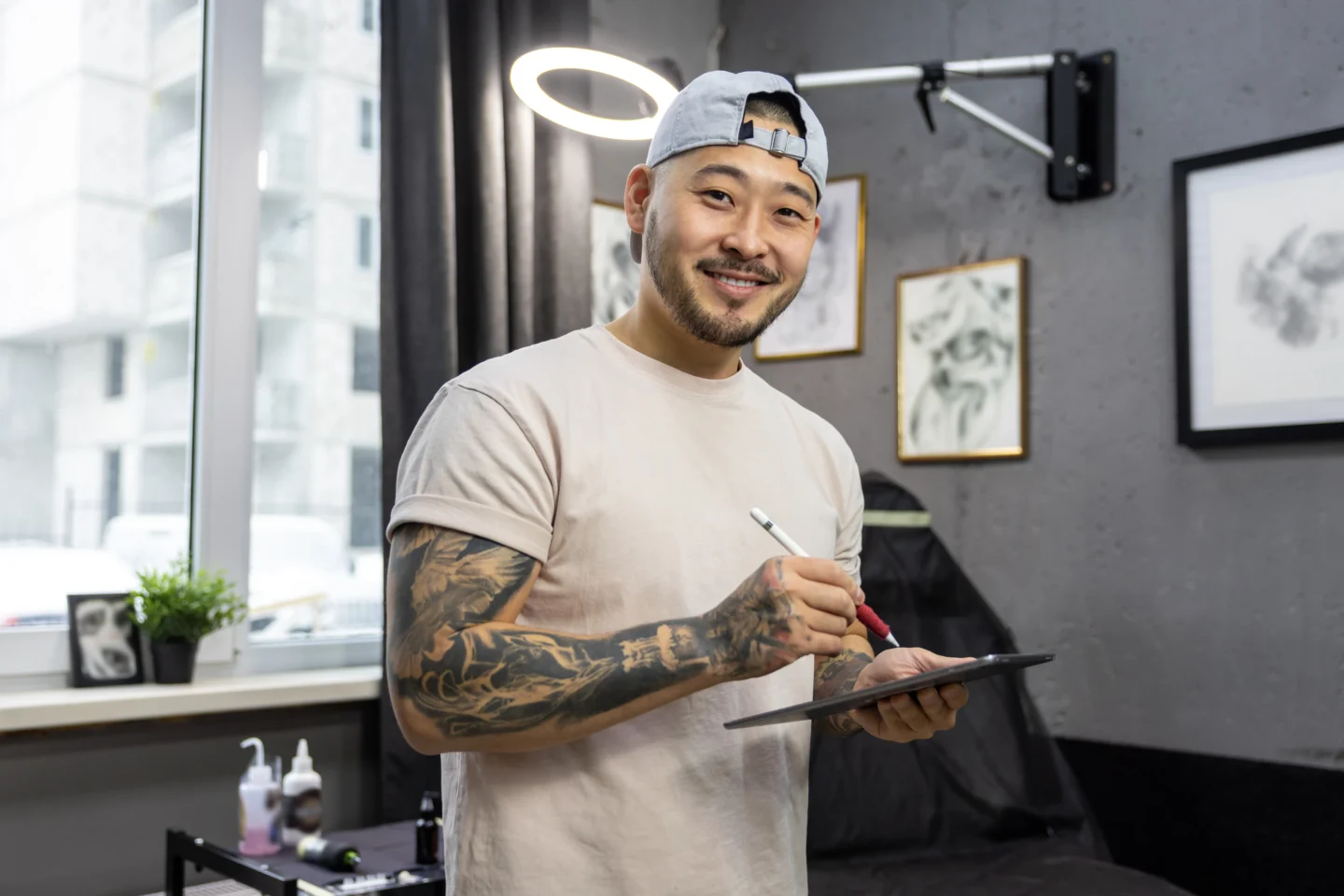
In the world of tattooing, there are two radically different approaches to creating a design on the skin.
We are talking about:
- Stencil tattooing, a method currently widely used by tattoo artists to transfer the design onto the skin
- Freehand tattooing, a more creative alternative where the design is drawn directly on the skin
In this article, we will analyze these two approaches, the choice of which generally depends on the type of design, the tattoo artist’s preference, and the client’s requests.
The Freehand Technique: Freehand Tattooing
In the Freehand technique, the tattoo artist draws directly on the client’s skin, without a fixed reference like when using a pre-prepared stencil.
Freehand tattooing therefore offers the possibility to express greater creativity and to create highly personalized, unique, and original tattoos, different from all others and often not replicable.
However, it is a more complex approach that requires a high level of preparation, experience, and confidence, as well as great manual skills and technique and complete mastery of advanced artistic skills.
Freehand tattooing also requires more time to create the design, but it also guarantees a more natural, organic, and harmonious result with the body’s forms, as well as a real connection with the person being tattooed.
The procedure involves an initial preliminary consultation, useful not only for understanding the client’s requests and desires but also for identifying the style, colors, dimensions, and details of the design.
After that, the tattoo artist proceeds by creating the sketch on paper, which is shown to the client and finalized according to their taste, and then by creating the design on the skin, before the actual tattooing.
Freehanding is an ideal technique, especially for:
- Cover-ups of existing tattoos
- Highly personalized tattoos
- Free-style projects
The Freehand Technique for Cover-ups
The freehand tattooing technique is very useful when it is necessary to proceed with the cover-up of an existing tattoo.
Thanks to Freehand, the tattoo artist has greater freedom of “action”: they can create a completely personalized design, capable of adapting to the shape, color, and size of the previous tattoo to be “hidden,” regardless of its location on the body.
Since it is drawn directly on the skin, the new design will completely cover the old tattoo, avoiding placement errors and following the body’s curves and features.
In this case, drawing with a stencil could have limitations, resulting in an imperfect cover-up or a “forced” and constrained design.
The Freehand Technique for Personalized Tattoos
Based on hand drawing, the freehand technique is ideal for tattoo artists who wish to create unique and original projects.
This approach allows for creativity beyond all limits and for obtaining personalized projects even by mixing different tattoo styles.
Furthermore, it is a technique that allows for effectively responding to the client’s desires and requests, as the design is custom-made and does not follow pre-prepared designs.
The Freehand Technique for Free-Style Projects
Thanks to its freedom of adaptation to the client’s body, the freehand technique is perfectly suited for free-style projects (such as biomechanical and sketch), as the tattoo is developed directly on the skin.
The result is unique and dynamic tattoos that follow the body’s anatomy and integrate harmoniously into the area where they are created, utilizing lines and curves to integrate or hide elements.
The Stencil Tattoo Technique
In stencil tattooing, the design is prepared in advance on paper or a digital medium, then traced or printed onto a stencil, and subsequently transferred to the skin.
The stencil is therefore a very useful tool for a tattoo artist, as it represents a kind of precise guide to follow during the tattooing process and ensures faster work, without smudges or errors, and precise and detailed tattoos. Furthermore, it also allows the client to see in advance what the final result will be.
Currently, the most common stencil on the market consists of a special paper made of 4 layers, namely:
- Top layer (transparent) where the design is imprinted
- Middle layer (onion sheet), which protects the bottom part
- Carbon, which transfers the design to the top sheet
- Bottom layer (with pigment), which contains the transferable ink
Stencil tattooing is ideal for:
- Complex, symmetrical, or detailed designs
- Tattoos with exact proportions
- Large-scale tattoos
Stencil Tattoo for Complex, Symmetrical, and Detailed Designs
By allowing even the smallest detail of the design to be accurately reproduced on the skin, the stencil is ideal for tattoos that require extreme precision.
We are talking, for example, about tattoos made of very thin lines, delicate proportions, and intricate strokes, portraits and realistic tattoos, and for mandalas or geometric patterns that require a perfect balance in proportions and spacing.
The stencil ensures a faithful and millimeter-precise result, avoiding any type of error and guaranteeing a combination of creativity and technical precision for an aesthetically impeccable outcome.
Stencil Tattoo for Large-Scale Tattoos
When creating a large-scale tattoo, such as a back piece or an entire leg, the stencil ensures maximum precision, consistency, and an aesthetically impeccable result.
This tool not only allows for creating designs that cover large areas of the body without having to divide the design into multiple parts, thus integrating all elements harmoniously, but also for placing each element in the ideal position.
Using a stencil also allows the tattoo artist to focus on the execution of the tattoo, without constantly recalculating proportions or positions, thus avoiding errors during the process.
Stencil Tattoo for Standardized Tattoos
When you want to achieve a standardized tattoo that can be replicated multiple times in the exact same way, the stencil is the perfect solution.
This technique is indeed the winning choice when it comes to predefined designs that need to be precisely tattooed on multiple clients, such as couple tattoos, frequently requested trendy tattoos, or symbolic tattoos.
The stencil allows for offering replicable designs without significant modifications, so that each tattoo is identical to the original, with the same symmetry and proportions as the initial one.
The Mixed Technique Combining Stencil and Freehand Tattooing
There are also tattoos that require both techniques listed.
We are talking, for example, about Japanese tattoos, where preparing the main subjects with their details on paper is very useful, which then need to be integrated with freehand drawn backgrounds to adapt everything to the body’s anatomical forms.
The mixed technique that combines stencil and freehand allows for a visually complex and personalized result, uniting precision and spontaneous creativity.
In this way, each tattoo becomes unique, combining the structure of the pre-planned design with dynamic and spontaneous details.
The Tattoo Artist Course at Milano Tattoo School
Milano Tattoo School is the School of Excellence for anyone who wishes to become a professional tattoo artist and learn to use both the Freehand and stencil techniques.
Within MTS, the Tattoo Artist Course of 1550 hours has been developed: a complete program that allows you to transform your passion and art into a successful career.
What does the MTS course offer?
- Professional Certification from the Lombardy Region, valid throughout Italy and at a European level
- 1,500 hours of theoretical and practical training to acquire technical, artistic, and management skills
- High-quality materials included: you will work with coil, rotary, and tattoo pens provided by Dormouse, a leader in tattoo equipment
- Personalized support: expert instructors, professionals, and a dedicated staff will guide you step by step
- Internships in professional studios to enter the job market
Thanks to the variety of tools and techniques, MTS allows you to explore your personal style and prepare to best meet the needs of future clients.
The goal is to train complete and professional tattoo artists, capable of combining passion, creativity, and competence.
The next Tattoo Artist course starts on January 13, 2025, and there are only a few spots left!
Visit the page dedicated to upcoming Tattoo Artist Courses