
Ornamental tattooing is a tattoo style characterized by precision, symmetry, and deep symbolism.
It combines minimalist aesthetics and spirituality and blends technical rigor and artistic vision, making it the ideal choice for those looking for a clean and fascinating design on skin, whether for small minimalist tattoos or larger, more complex ones, as well as for full-body tattoos.
It is based on the use of precise shapes, which can also be combined to create abstract patterns and mandalas, each with a meaning:
- The circle symbolizes perfection and continuity
- The triangle, depending on its orientation, represents masculinity or femininity, fire or water, and extreme balance.
- The square indicates stability, integrity, and rationality.
pentagons and hexagons recall nature and the harmony between man and the divine. - The spiral evokes growth and transformation.
- the infinity symbol represents eternity
Ornamental tattooing has ancient roots: it was used in civilizations like Ancient Egypt or by indigenous cultures to accompany protection or passage rites, later representing everyday objects, sacred figures, and increasingly complex elements.
Today, these tattoos are the result of a fusion between tradition and modernity. Ancient shapes full of symbolic meaning are integrated into ornamental compositions designed to enhance the body’s aesthetics.
Different types of ornamental tattoos
Ornamental tattooing is divided into several sub-styles, each with unique characteristics. Among the main and most widespread, we find:
- Mandalas and spiritual motifs: they are inspired by symbolism and represent balance, perfection, and spirituality. They are composed of concentric shapes and are mainly performed on the back, chest, and arms—large areas that allow the design to develop.
- Linework: these tattoos use sharp, thin, and clean lines to create designs with abstract geometric shapes, architectural patterns, or mathematical details.
- Dotwork: composed of thousands of dots, dotwork tattoos create textures and shades through the density of the stippling. Ideal for delicate and gradual visual effects, it requires patience and constant needle control.
- Patterns and ornaments: repetitions of geometric elements, often inspired by fabrics, mosaics, or natural structures. They are adapted to the body’s morphology and can cover large surfaces like arms, legs, or the torso.
Techniques for performing a perfect ornamental tattoo
Creating an ornamental tattoo requires, on the part of the tattoo artist, maximum precision, a steady hand, a keen eye for the smallest particular, and extreme attention to details.
Every line must be perfectly straight and uniform, while the dots must create flawless and orderly shadows and textures. For this reason, the use of thin needles is fundamental to performing tattoos with clarity and definition.
Symmetry is a central element in this style and ensures the design’s sharpness and readability even after years.
In detail, these tattoos require:
- Planning and the role of the preliminary drawing
- Specific tools and needles
- Alignment techniques and stencil use
Planning and the role of the preliminary drawing
Like every tattoo, the geometric/ornamental one must always start with careful planning.
This means perfectly executing the drawing, which must be studied based on the body area, taking into account any curves and irregularities and then harmonized on the client’s body.
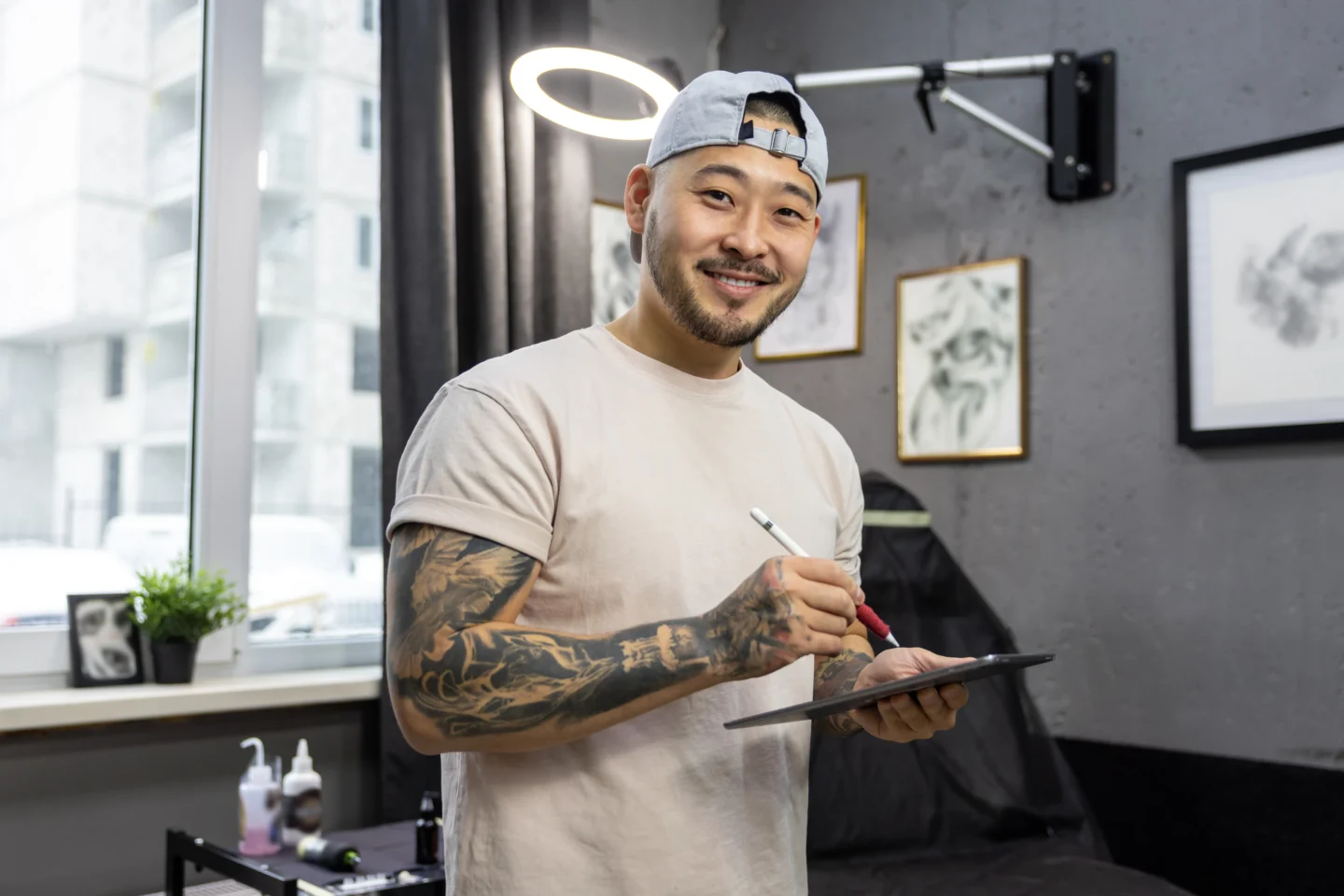
It is fundamental to test the alignment, symmetry, and repeatability of the geometric modules. The drawing can be done by hand or, when dealing with particularly complex designs, it is possible to use software like Procreate, which is part of the artistic offering at Milano Tattoo School.
Specific tools and needles
The creation of ornamental tattoos requires specific tattoo needles, also depending on the style and technique.
For linework, round liner needles are preferred, depending on the required fineness. Dotwork instead requires single needles or small round shaders, ideal for dot control.
Rotary or pen machines are often preferred for their stability and precision, fundamental for this type of style. The choice of black ink is also crucial: it must be dense, deep, and uniform.
Alignment techniques and stencil use
The stencil is the starting point for maintaining visual order in ornamental tattoos.
It is essential to position it with millimeter precision. Furthermore, it is also very important to check the position on the body in motion. It is often useful to divide the work into modules and proceed by sections, avoiding errors on large surfaces.
Ornamental tattooing: common challenges and practical solutions
The beauty of ornamental tattoos involves millimeter precision, consistency of shapes, and overall harmony of the design: only in this way is it possible to obtain flawless results.
For this reason, it represents one of the most complex styles to perform, as any imperfection is immediately visible.
The main difficulty for a tattoo artist is managing proportions on irregular surfaces, typical of the human body and very different from the flat paper on which the preliminary drawing is made. The solution, in this case, is to create digital 3D models or use flexible stencils to be tested directly on the skin before execution.
Another difficulty lies in symmetry: even the smallest misalignment can be obvious to the eye and ruin the overall effect. It therefore becomes important to practice and gain experience, factors that allow for maintaining perfect proportions.
Furthermore, unlike other styles, the ornamental one offers little possibility to “hide” errors. Any inaccuracy can force creative changes to the design or require more invasive interventions, such as a cover-up or a restructuring of the pattern.
The advice is therefore to specialize in this style before testing it on clients. Only good tattoo artists are able to best manage possible errors.
Finally, ornamental tattoos, especially if extensive or complex, require long sessions and a constant level of concentration. A drop in attention for even just a few minutes can compromise hours of work.
Become a professional tattoo artist with courses from the leading Italian training school
Milano Tattoo School offers professional training designed for those who want to specialize in the geometric style as well, combining theory, technique, precision, and creativity.
In our 1500-hour courses accredited by the Lombardy Region, every tattoo style is explored in depth through:
- Specific exercises and live demonstrations
- Guided practice on synthetic and real skin
- Professional use of digital tools (iPad, Procreate)
- Mentoring with expert teachers in the field
- Workshops and masterclasses with international tattoo artists
The goal is to train complete artists, capable of facing the challenges of every style with technical awareness and creative autonomy.
Do you want to become an expert in ornamental tattoos and make it your strength?
Milano Tattoo School is your chance to acquire professional skills, recognized certifications, and real job opportunities in the world of contemporary tattooing.
The next tattoo operator course is starting on September 1, 2025.
Visit the dedicated page to discover the entire program and how to enroll