
Since its widespread adoption, Artificial Intelligence has literally changed the world and transformed the way many sectors, professionals, and businesses operate.
This trend hasn’t spared the tattoo industry, where AI has paved the way for new possibilities aimed at improving efficiency, creativity, and precision in tattooing.
And while the future is already talking about machines that tattoo autonomously or that provide excellent suggestions for ink colors to use, in this article we want to analyze how Artificial Intelligence is changing the world of tattoos in the present.
How is AI applied in the tattoo landscape?
The first major contribution of Artificial Intelligence in the world of tattoos is related to design.
Using graphic generation tools based on advanced algorithms, this new technology allows you not only to get inspiration and suggestions to bring completely original drawings to life, but also to create unique and highly personalized designs from scratch.
With AI, starting from specific client requests, it is actually possible to create quick drafts in every type of tattoo style (Japanese, realistic, fine line, traditional, etc.) and experiment with infinite design variations by modifying colors, sizes, body areas, shapes, and aesthetic preferences.
This is done both by using text prompts to generate a tattoo design and by leveraging existing images to obtain similar but original tattoos.
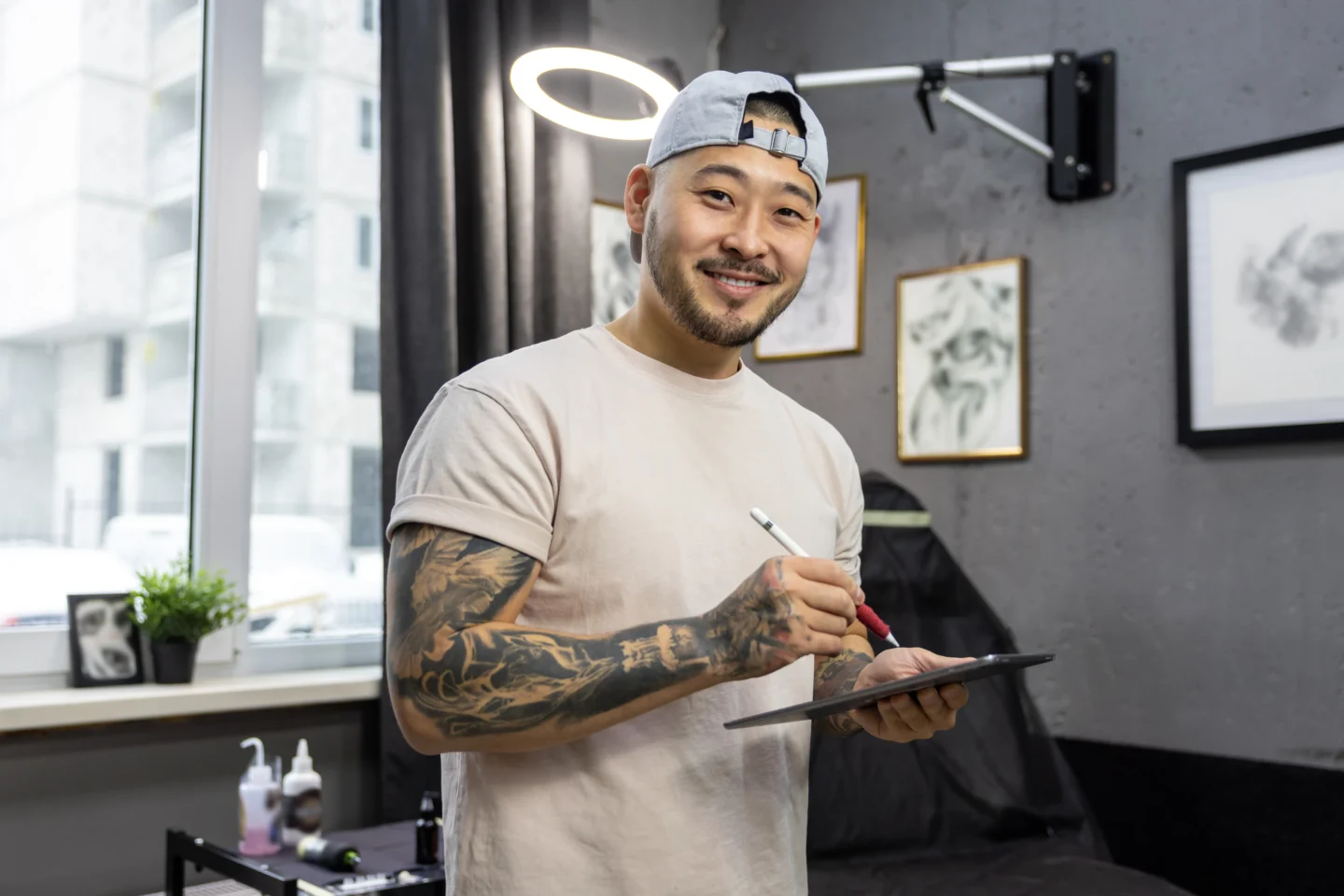
Artificial Intelligence is also transforming the tattoo sector at the creative process level, helping tattoo artists optimize their time and work through tools that allow them to:
- Convert freehand drawings into digital formats to be transferred onto the skin
- Create complex details almost in real-time
- Get feedback on designs and advice on any changes to be made
- Simulate the tattooing process on virtual skin to avoid mistakes
- Speed up the tattoo design phase
- Create stencils
The meeting of Artificial Intelligence and Augmented Reality (AR) also guarantees the possibility of viewing an extremely realistic preview of the finished tattoo (how the tattoo will look directly on the skin): this is a fundamental aid that allows for adjustments to size, placement, and colors before moving on to the actual execution.
Finally, for the tattoo industry, Artificial Intelligence also has crucial value from the perspective of sustainability and safety: it contributes not only to improving the use of materials (for example, by precisely calculating the amount of ink needed) but also allows for the analysis of the client’s skin conditions to avoid any risks.
Lastly, by analyzing huge amounts of data in very short times, AI ensures a constant and continuous update with the latest global market trends, thus helping tattoo artists stay up to date with trends and fashions.
All this makes it clear that while it’s true that AI won’t replace tattoo artists, it’s equally true that it represents a very useful innovation to improve their work and expand creative possibilities.
This also means that, thanks to this technology, tattoo artists can push the boundaries of their art, experimenting with complex and innovative designs and trying to work even on styles that are “further away” from their usual repertoire.
AI and tattoos: pros and cons
As we explained above, Artificial Intelligence has brought (and is still bringing) huge advantages to the tattoo sector, including:
- Optimization of the creative and design process
- Creation of infinite design variations in just a few minutes
- Creation of original designs based on client preferences
- Improvement of precision, proportions, symmetry, and details
- Real-time feedback to make necessary changes
- Virtual simulations to practice technique and manual skills
- Advice on materials and tools to maximize results
For every “pro,” however, there is almost always a “con.”
In this case, a possible issue in using AI could be the reduction of originality and artistic creativity, which are core skills for every professional tattoo artist.
There is indeed a risk that, especially over time, a tattoo made through automation will be less unique and less personal than those created by hand, and that by constantly using automatically generated models, the designs will end up being standardized, too similar to one another, and less exclusive.
Another concern is related to the misuse of AI: by giving imprecise inputs or poorly detailed information, this technology could actually create incorrect designs that don’t respect certain symbols or specific cultural traditions, or that lack depth.
Finally, the use of Artificial Intelligence, especially for younger or novice tattoo artists, also risks compromising the development of necessary skills, such as freehand drawing or stencil creation, as well as reducing the human relationship that must be established between the artist and the client.
For all these reasons, a perfect balance between tradition and technology is necessary to preserve the artistic essence of this ancient art form and all its historical values.
Can Artificial Intelligence really replace the tattoo artist?
To the question “can AI replace the tattoo artist,” we answer with a categorical no: the role of the tattoo artist remains irreplaceable.
This is not only because AI is not yet able to actually tattoo (and perhaps never will be), but also and above all because it doesn’t guarantee that “human touch” that is indispensable in this profession.
We are talking about the artistic intuition and creative skill typical of a human tattoo artist and developed over years of experience, capable of transforming a story into a masterpiece on skin in a way that AI cannot replicate.
But we are also talking about welcoming a client into the studio, creating a relationship of trust with them to reassure and guide them through the process, the care for the artwork to be created, and all the advice for achieving perfect healing.
Furthermore, every tattoo (even if created via AI) is unique and almost always requires human intervention to improve it, adjust it, and make it 100% tailored to the person who will wear it forever.
In addition, the tattoo artist must step in to understand where to correctly position the tattoo on the body according to the specific anatomy and must also adjust the colors to make them stand out best depending on the tone and type of skin being tattooed.
In summary, as we have tried to explain in this article, Artificial Intelligence is an innovative technology that can support and even optimize certain aspects of a tattoo artist’s work, but it cannot replace it entirely.
MTS courses to become the tattoo artists of the future
Even though at Milano Tattoo School we stay updated on the latest news in the tattoo sector and the most innovative technologies related to this world, we are oriented toward a more traditional approach when it comes to training the tattoo artists of the future.
For this reason, we have developed a 1500-hour program that represents the ideal starting point for those who want to enter the sector, with comprehensive training that combines theory, practice, and an internship, culminating in the award of the Regional Certification, valid throughout Italy and Europe.
During the course, every student develops unique technical and artistic skills, practicing on paper, iPad, and synthetic skin, until the big moment of the first tattoo on a real person!
Furthermore, MTS guarantees participation in exclusive workshops with international artists, providing inspiration by learning from the best.
With a team of 20 expert tattoo artists and 500 hours of internship in affiliated studios, at the end of the program, you are ready to face the working world with confidence and creativity.
The new year at Milano Tattoo School opens with a great opportunity for those who dream of making tattooing a profession: on January 13, 2025, the first MTS Tattoo Operator Course of 2025 kicks off, and spots are running out!